
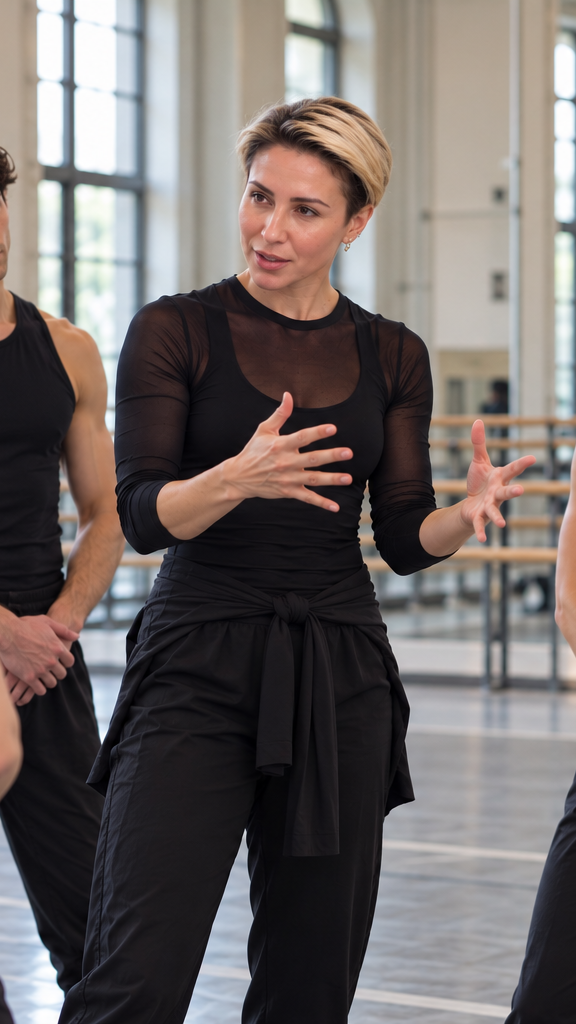
I help dancers and educators understand the why.
The challenge of controlling the movement of my body with my brain started at five years old. To this day, I still have to teach my brain where my body sits in space and how to move in ways that promote both excellence and longevity.
However, you might be wondering where my passion for science in dance comes from. It certainly wasn't a noticeable part of my training growing up, nor did I have any major exposure to science-based training beyond a few physiotherapy workshops, which focused more on injury prevention than performance.
It all started when I lost my ability to move at 16.
The injury itself happened when I was 12. I was competing in high jump, cleared the bar and went straight over the landing mat onto the concrete. The man responsible for setting up the girls' side of the track and field stood over me while I lay in immense pain and said, “Oh, I didn't know girls could jump that far.”
Although incredibly sexist, that moment taught me something else of great value: how easily youth sport safety can be overlooked, even at the most basic level. It also made me question how little consideration was being given to the physical capabilities of young female athletes, particularly during periods of growth and maturation.
Four years later, after winning Miss Dance of America at 16, I returned home and went back to school. One day, I stood up from a chair, and with that tiny movement, I was suddenly unable to walk.
It turned out I had fractures involving my lower spine, from my tailbone to L5, as well as my hip. I had danced for four years with a broken back and hip, and no one had recognised what was happening, despite changes in my performance, obvious compensations and other physical signs that something wasn't right. I was pushed, I pushed myself, and after winning Miss Dance of America, my body finally gave up.
This led me on an extraordinary teaching journey.
One minute I was fine; the next, I was unable to walk. There were periods when I had to teach from the floor for months at a time. Although I didn't know it then, this became a blessing in disguise.
I started seeing the body in extraordinary ways. I became increasingly aware of angles, weight distribution and how movement could be developed through carefully designed progressions. I began creating my own screens and finding ways to teach through verbal instruction alone, solving a whole host of challenges when physical demonstration and hands-on teaching weren't always options.
This included difficult genres such as contemporary dance and dance acrobatics. In fact, if I told you that I almost never physically spot a dancer, you might be surprised. But that is precisely why I place so much emphasis on preparation, progression and understanding what a dancer needs before attempting a skill.
Over time, I realised that my students were becoming physically impressive, technically capable and developing skills through approaches that placed considerable emphasis on safety and long-term development. I was also using many of these same teaching principles in my own rehabilitation.
But I needed to understand more.
I could see what was working in my teaching, but I wanted to understand why it was working. I wanted to know what the science actually said, how to evaluate my methods and whether there were better ways to develop dancers.
The next obvious progression for me was pursuing not one, but two master's degrees: Applied Sport Science and Secondary Education.
I wanted to close major gaps in my knowledge that I had struggled to address through the dance industry alone. By looking towards more scientifically established fields such as sport science and education, I began developing a deeper understanding of coaching, physical development, skill acquisition, pedagogy and how to make decisions informed by both research evidence and professional judgement.
Dance training is truly a complex problem, and one I am excited to continue exploring through interdisciplinary research, collaboration and a lifelong desire to work with all bodies within dance.
—
Ashley Grottoli
Educator, Mentor
Bringing Science Into Every Dance Environment.
Strength, conditioning and performance development for pre-professional and professional dancers. In-person and remote available.
Dance science, coaching science, biomechanics and training principles. Bringing the most innovative and current research to you and your team.